Dragons, travel, and a whole lotta Yerba Mate with a Texan-Argentine: an interview with Iván Brave, author of the language-bending The Summer Abroad.

Who is your favorite dragon in literature?
Please help me remember the title of this children’s story, but I remember a chapter book that began with a young boy frustrated with school, walking home, and turning left on a street he had never seen before, where he comes across a curious antique store unlike any other. Inside, he finds a dragon egg! He asks the owner if it’s a real dragon egg. “Of course,” says the owner. “And it’ll cost you 25 cents.”
I swear, from then on in real life, for years actually, I carried around a quarter in my pocket. Because the egg in the story really was a dragon egg. And the boy and the dragon became best friends. (I have yet to come across a similarly curious antique store, but fingers crossed.)
Rose: Sadly I don’t know either! Can anyone help us out on this one?
Have you ever been to Melbourne?
Not yet. But c’mon, the Great Ocean Road? The skiing? I hear, also, that the music scene is really cool there. Some of my favorite bands are from Melbourne, in fact. Cut Copy, Miami Horror… let us not forget Men at Work.
 What is the story behind your name?
I actually write about this on my Facebook author page. My last name is French, my first name is Russian. My family grew up in Argentina, and all over the world.
Over the years, what would you say has improved significantly in your writing?
Everything: dialogues, precision of speech, general vocabulary, a sense of freedom when I write (this above all else, if I had to pick, this has improved in my writing). But overall, there is no area I am not interested in improving, in not getting just right. I think this is something most writers share: the desire to improve — not only our writing, but ourselves as writers, ourselves as people.
Some authors are able to pump out a novel a year and still be filled with inspiration. Is this the case for you, or do you like to let an idea percolate for a couple of years in order to get a beautiful novel?
When I decided to make writing my career, I had this notion that I would complete an entire writing project every six months. I was on a roll for a while. I wrote a novella in the fall of 2013, a novel (available next week on Amazon paperback) in the spring of 2014, another in the fall of that year. But as the months went by, and the temptation to return to old projects crept up from under my desk, I slowed down. Now I’m sitting on four full projects, and I would like to see them each realized before drafting more.
This has been my mantra lately: “Better finished than perfect.” This has helped me, not just to go back and finish those early projects, but also to let them go. Hence the publication next week.
I have heard of writers that could only write in one place – then that cafe closed down and they could no longer write! Where do you find yourself writing most often, and on what medium (pen/paper or digital)?
My writing desk, at home. Right now it’s in my bedroom (thank you, New York sq footage). But I wouldn’t be opposed to separating my dream space from my work space.
I can write outside, I can write in public. I have even enjoyed writing in a car, in a train, on a plane. But my most comfortable, long-term, steady (it’s sounding like a relationship now) space is at my writing desk. It works for me, feels safe, plus I have all my knick-knacks and candles there.
I walk past bookshops and am drawn in by the smell of the books – ebooks simply don’t have the same attraction for me. Does this happen to you, and do you have a favourite bookshop? Or perhaps you are an e-reader fan… where do you source most of your material from?
I am on the verge of buying an e-reader. They seem useful for reading fast and keeping a large volume of text with you at once. But, like you, I am of the hard-copy kind. Smell, touch, bend, tear, underline, toss. There is something (many things) about the book that made me want to write books in the first place. I can’t forget it.
I shop at three places in New York City: The Strand on 14th St; McNally Jackson, also in Manhattan; and Word, in Greenpoint, Brooklyn. Of course I stop at every pile of books on any sidewalk I come across. Amazon is useful for sourcing books too, can’t deny that. If I need an obscure text on literary theory, and fast, chances are a local book store has already put it for sale online.
I used to find myself buying books in only one genre (fantasy) before I started writing this blog. What is your favourite genre, and have your tastes changed over time?
I. Will. Read. Anything. Right now I am finishing the Elena Ferrante Neapolitan novels. That’s about friendship, family drama, a series of novels. Next I want to read a memoir-response to a memoir I read recently. After that I want to read the Gospels (yes, the Gospels!) over the holidays, because I’ve never read them all the way through with a literary eye. After that I have three books of literary theory (one that a student of mine gifted me just today; boy, does the queue grow long, or what?) Before Ferrante I was reading a Spanish humorist, before that Argentine Sci-fi…
Basically, all over the place. And I think my writing reflects that. Never mind, I know my writing reflects that. I have an eclectic taste, I like it all, and, let’s just say, I like to mix paints when I color.
Tea, Coffee, or…
Tea weekday mornings, espresso when I travel, and coffee for special occasions. On weekends and on days when I feel especially myself, I like to drink Yerba Mate, an herbal tea from South America, where my family is from. To be honest, we drink a lot of mate. A whole lot. It’s almost a vice.
Where can we find a copy of your debut novel?
Right now for Kindle on Amazon. The print edition comes out in a week, for those of us who enjoy the smell and touch of books.
A Summer Abroad
Late May, 2013. Three rough and rowdy Texan boys embark on a summer long journey to Europe. Like most wanderlust youth fresh out of college, these best friends encounter twisted new characters, living proof of old stereotypes, and a string of hostels so bad that they are actually good. Unfortunately, such naivety leads to heartbreak and resentment among them. In the end, their friendship is strained, egos bruised, when the story’s narrator finds himself not where he started, but alone.
The Summer Abroad (or, in Spanish, El viaje de egresados), is a sonic adventure — at times fast and delirious — that explores the frontiers of language and a new American identity, one which is multilingual, multicultural, and, as the story puts it, “multiconfundido.”


 This is a lighthearted romance with a spot of dog-loving thrown in! Cora’s a likable enough character who creates laughter with her descriptions of dogs-gone-wrong. There are sad parts to the novel too, but nothing particularly cry worthy. If you’re looking for a beach-side read, this novel could be it. This novel is decidedly chaste, so don’t go looking for sex scenes.
 Despite the somewhat gory descriptions of Rhino poaching, this book is definitely suitable for younger readers interested in animals. I’m going to try it for a 9.5 year old girl who is passionate about reading and David Attenborough films. It’s a great primer about both the glory and the boredom of being a vet in practice.
 Tris seems to lack a survival instinct, as well as an ability to actually communicate with people! So much drama could have been avoided by ‘using her words’. The same goes for the rest of the characters – talking is a good thing, people! This frustrated me at times because it meant that the perspective was very limited from Tris and I thought there was so much more about this world that I could have enjoyed if I had been given a chance.


 Noah’s perspective is interspersed with his mentor’s and a potential love interest. This gives the reader a bit of variety, and also makes them feel Noah’s growing sense of horror as he realises what he and others have done in the name of safety. I wanted to be horrified when Noah tortured people, but I just wasn’t. I felt as numb as he did.
 This novel put the creepy factor up high right from the beginning and it only got worse (or better?)! This is a true psychological thriller that caused me to shiver and make sure I had a good grip on myself (and my stomach). Some of the passages when Naomi were alone almost took my breath away.
 It’s very difficult to review a book that is filled with images – you just need to see them for yourself. For example, there is an Escher tattoo and some visual puzzles that if the artist had gotten a tiny bit wrong, it would have been wreaked. There’s a kitten and a dinosaur, and you better believe every hair on that kitten is visible.
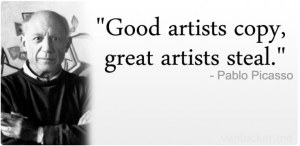 We all know some rules are made to be broken, because they were poorly thought out in the first place, but many great authors have overturned the window of what is acceptable in writing by figuring out when a previously sacred rule should be broken. Now I’m not one of the greats, but I do love breaking rules. The minute someone tells me one I’m already wondering how I can break it. It’s a mini act of rebellion against the fusty old English teachers who tried to teach me grammar. I revel to know they’ll be turning in their metaphorical graves the moment I start a sentence with a conjunction, or use a sentence fragment. And yet it’s something that great authors do. All the time.
 A famous example of blatant rule breaking is Iain Banks’ story Feersum Endjinn. Iain wanted to tell a story about a nearly illiterate character, so he did the unthinkable, he made his readers wade through pages of phonetic writing. And it worked. Even though many people really hated the book because of this choice, I believe it was the best way of presenting that character.
