Review: Helen Hoang – The Bride Test

The Bride Test
Helen Hoang

Khai doesn’t need relationships – he’s not lonely. Esme doesn’t think she needs to get married, since she has her daughter already. But both of them could be happier if they had someone in their lives. Esme can stay in the USA if she can marry him – but can she love him as well?

Ah, I wouldn’t have called this The Bride Test. Is Esme really tested? Or is it Khai who has to decide what he really wants? I loved reading their different perspectives and how the times almost overlapped, and that arg! How could they both think such different things about the same interactions? Well, since Khai identifies as having Autism, yes, it’s clear how that can be the case. It’s nice to see a non-neurotypical writer commenting and writing on a topic that she is surely intimately familiar with.

This novel has some HOT sex scenes that surprisingly didn’t make me cringe too much! Khai’s first time is adorable. There’s a lot of time spent thinking about penises because Khai is sexually frustrated, so if that’s not your thing, perhaps don’t pick this novel up. Esme is so comfortable with her body that it’s really freeing to read about.

GoodReads has this tagged as ‘The Kiss Quotient #2′ but it has NOTHING to do with Helen Hoang’s other novel. Yes, they both have autistic protagonists and are hot romances, but that’s it. They don’t contain any of the same characters.

You know, I read this the moment it got inside my front door like a ravaging maniac. Then I didn’t review it because I went on holidays. So then, oh, poor me, I had to read it again! And so I’ll give it 5 stars. I can’t wait for Helen Hoang’s next novel.

Allen & Unwin | 1st July 2019 | $33.99 | paperback

Review: Caroline Bond – The Forgotten Sister

The Forgotten Sister
Caroline Bond

Cassie hasn’t thought about the fact that she was adopted. She’s been happy with her adoptive family up until this point. But are they hiding something from her? And if they are hiding something, is it for her own good?

You know, you’d think that fiction characters, particularly those that have adopted children, would learn to be more open about things. Every time I get a side conversation being held between parents I automatically think that something is going to go wrong – and unfortunately that’s normally the main plot point of the novel, just as it is here.

I found the inserts from Cassie’s dad quite distracting, and I didn’t feel like they added anything to the story. It could have equally been told from Grace’s (the mother) perspective and not lost anything in my opinion. I did like Ryan’s perspective, and Erin’s though. Overall, I could have just had the novel told to me from Cassie, Grace and Leah’s perspectives if that meant that their characters and motivations were a little more fleshed out.

I found Leah a bit… intense? And thus I found the ending quite unbelievable. I could have done without it, actually. What is with novels wanting to add a little post-script to a perfectly good novel? I didn’t find it heartbreaking or tear jerking, perhaps because I could never think of Leah anything other than a bit crazy. Going through the Foster Care system is enough to drive anyone mad! In fact, another novel I read recently was about that – Stone Girl.

This novel left me feeling a bit ambivalent, which I guess means it’s a 3 star. Not terrible, but not remarkable either.

Allen & Unwin | 3rd June 2019 | AU$29.99 | paperback

Review: Gena Showalter – Firstlife

Firstlife
Gena Showalter

Prynne Asylum is the home of underage children that won’t do what their parents want them to do – whether it’s getting married or Choosing the right Second Life provider. Tenley’s been tortured for longer than she thought was possible, but she’s determined not to Choose Myriad or Troika. The two realms are determined to get her on their sides though – and she might die anyway.

How dumb can one girl be? It’s clearly obvious which side she’s going to pick. Oh boo hoo, your boy toy isn’t from the same place. Oh no! You might war with your parents for forever! Get over it! Choose based on what you see, not what people tell you. She’s all about being strong and kicking people in the balls (literally and figuratively) and then she’s just bowled over by good old Killian because he smells good.

Let’s not forget the inclusion of a weird psychic, and a suddenly discovered clause that that means that Ten isn’t her parents’ meal ticket any more. Oh, and the fact that Ten can recover from basically any injury (and so can the other humans) within the space of what seems to be hours. She ends up dying at least twice, and then she’s brought back. So really, who cares? I couldn’t get attached.

Ten’s pretty obsessed with numbers, but honestly I think it’s a load of bunkem. Any number can be special if you would like it to be! I’m personally quite fond of the number 13 because everyone says it’s unlucky. But I could equally choose 11, because it’s the first double digit prime number, or 2 because it’s the only even prime number. Tenley’s form of swearing is to say ‘zero’ to herself!

I waded my way through quite a lot of this novel before I gave up and read the synopsis on GoodReads for it, and the following two novels. 1 star – I didn’t finish it, don’t bother.

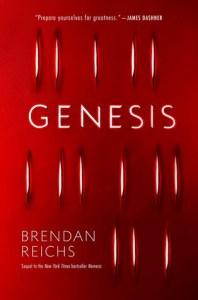
Review: Brendan Reichs – Nemesis

Nemesis
Brendan Reichs

Every two years Min is murdered on her birthday – but she finds herself alive again soon after, with no evidence of death left. An asteroid is approaching earth though, and weird things keep happening that might wipe out human kind. It’s good thing she has Tack by her side – and maybe the stranger Noah as well?

This novel was very, very slow and I considered giving up on it about half way through. Min and Noah are like two magnets that kept changing polarities. Oh, and then when the perspectives started changing I started feeling very irritated. Just stick with a side guys! Noah, please get over yourself, I get that you might have anxiety, but I don’t think you’re really convincing me with your character consistency.

Ok, something I really struggled with was the ending of this novel. Noah’s personality basically completely changes – and I had no idea why. Min stays her own awesome self as far as I can tell. I also really don’t get how what they think is happening could happen. I really can’t say more without giving away the twist.

This novel reminded me a little of The Maze Runner – but I think people actually die in that one! I have the second novel in this series waiting for me on my bookshelf at home, but I’m not sure I’m going to wait that long to read it (since there is an eBook copy available from my local library). I’ll give this one a healthy 3 stars, bordering on 4. I’m just not convinced about the ending.

Review: Susin Nielsen – No Fixed Address

No Fixed Address
Susin Nielsen

Felix and his mom Astrid live in a van. It’s a pretty cool van at the beginning, but as months go past, Felix gets more and more uncomfortable. He doesn’t get to shower every day, and school seems like the only place he’s warm and safe. Felix has a chance to go on a TV trivia show though and win the answer to their problems.

I didn’t feel convinced that Felix was 13. I felt that maybe he was a bit younger? I feel like by 13 I was a bit more put together, but maybe that’s because I’m a girl and we develop slightly faster than boys. I loved his relationships with his friends! And I liked how the novel was a mix of past and present tense – initially I felt a bit hesitant of it, but in the end it made sense.

I liked how it was just a slippery slope from a month’s holiday in a van through to spending a couple of months in it. It wasn’t ‘bam’ they’re homeless. I also liked how Felix described his mother’s depression slumps. To me, I don’t think her medication was doing a great job though.

This asks the reader to consider hard questions – what makes a good parent? Is foster care the right solution to problematic homes? Is stealing ever ok? Also it wants the reader to think about what they might feel like in that situation. Also, there were a couple of times where Felix made a statement to the police, yet it wasn’t followed up on.

This was entertaining (and sad) at the same time. I was particularly fond of Felix’s classifications of different types of lie. It was a very comfortable and undemanding holiday read.that I’d absolutely recommend for middle grade readers. 4 stars for its target age group.

Review: Amanda McClelland – Emergencies Only

Emergencies Only:
An Australian nurse’s journey through natural disasters, extreme poverty, civil wars and general chaos
Amanda McClelland

“In 2015, Amanda McClelland was awarded the Florence Nightingale Medal, in recognition of an extraordinary career dedicated to making a difference. As a nurse and a humanitarian aid worker she has battled against extreme poverty, disease epidemics and natural disasters, helping to rebuild broken lives and strengthen communities across the globe.”

I expected something more like Aussie Midwives or Island Nurses with more individual nursing stories. What I got though was a discussion of humanitarian aid and her movements from plain nursing through to team management and recommendations. Everything is underlined by her compassion and practicality as well.

Ew! Some of these stories are likely to horrify a weak-stomached reader. I couldn’t stop thinking about her just casually slicing out a pus filled ulcer on her chest! Others are just horrifyingly sad – mothers who lose their lives and also their babies, or babies that can’t possibly survive. She’s not a midwife, but looking after children and improving mortality rates ends up being a huge part of her job.

In a way, this book reminds me of How (not) to Start an Orphanage – it has both what should and shouldn’t be done, and talks about the hardships on essentially white people living in third world countries. Sometimes the interventions create more problems than they solve. Amanda really illuminates how the best of intentions can lead to problems if they aren’t carried out with the community’s support and full understanding.

What upsets me in general (not about this book at all) is how sometimes things at home should have been fixed before we go elsewhere to aid others. Amanda works in an indigenous community that is filled with drug and alcohol fueled violence and horrible living conditions in places. Maybe we should try to work out how we can help our own people first?

Review: S E Grove – The Waning Age

The Waning Age
SE Grove

Natalia has lost her empathetic little brother after a wayward comment at her workplace insults the wrong person. She’s also got a huge bounty on her head after she embarrasses a bunch of Fish. Fish are people who don’t have feelings, and also don’t follow society’s rational norms – they’re killers. Natalia is pretty sure she doesn’t have feelings left either – but she’s determined to get her brother back.

The premise of this novel is interesting. When children get to the age of 10 or so, they lose their ability to feel things. So then at high school they are taught society’s rules and norms for how to behave. Somehow people’s brains have switched off the pathways to being empathetic for others. It’s a cool idea! I’m not sure how biologically possible it is at this point though.

I’m not sure how I felt about the execution of this novel. Calvino’s essay responses add a bit of variety, but ultimately it is Natalia’s journal that carries the plot. The journal entries left me feeling like there was a lot more to be said. Now, if that was a deliberate idea on the author’s behalf, because of course Natalia doesn’t ‘feel’ things anymore, that’s ok. But I needed something more to connect me with the characters.

None of the characters I cared about died, and nothing bad really seemed to happen to them. Bad things were threatened, and people did die, but they weren’t really important. I was too sure the whole time that Natalia would win. And that ending with where Cal ends up? Isn’t that just too convenient? All those coincidences just seem to line up…

Natalia reminded me of Maggie in Disruption (I always have to look up the name of the novel, I can never remember it!). Despite everything going against her, and only the rich being able to afford the good things in life, Natalia sticks it out and kicks butt, just like Maggie! I’m going to give this 3 stars, and suggest instead that you go and read Disruption instead for a kick-ass heroine and a more convincing plot.

Review: Nicola Yoon – The Sun is also a Star

The Sun is also a Star
Nicola Yoon

Natasha will be deported before the day is out – but she’s willing to try anything to stay in America. Daniel happens to save her from being hit by a car, but he has his own life changing interview to attend. This novel is a story of how unexpected coincidences and fate can come together in just a single day.

Normally I would be irritated by a novel trying to cram too much importance into a single day. I thought to myself at the beginning of this one that I didn’t have much tolerance for the interspersed chapters from Natasha and Daniel, as well as the other randoms they happen to run into! But it grew on me, and in the end I was satisfied. I kept wanting to know the next coincidence to happen.

While I saw the ending coming, it was also very satisfying in a way that ‘Five years from now’ was not. It’s ok for people to drift apart! Even the epilogue was ok – I would have been ok with it not happening either. This book ended in a way that *Startalk* left me wanting. What’s wrong with an ending that isn’t roses for everyone?

I also read Everything, Everything a while back, and enjoyed it so when I saw this one I thought it could be a good distraction. I borrowed it through my local library’s eBook BorrowBox. Normally I hate reading on my phone, but in this case, it was convenient. I also saw a copy of it in a local (Greek) bookstore! I’m giving it 4 stars – I’m a little sad that I don’t own it, but I’m not going to rush out to buy it any time soon. Maybe if I saw it in a garage sale or similar.

Review: Kenneth Ring – Waiting to Die

Waiting to Die:
A Near-Death Researcher’s (Mostly Humorous) Reflections on His Own Endgame
Kenneth Ring

“During his many years researching the near-death experience (NDE), Dr. Kenneth Ring was concerned with answering the question, “What is it like to die?” In this book of fifteen sparkling and delightfully witty essays, his question becomes more personal, “What is it like waiting to die?” More specifically, what is it like for an octogenarian who has spent half his life studying and writing about NDEs to face his own mortality? ”

I was offered this book to review, and I was attracted to it because the author writes and researches near-death experiences (NDEs). Cool! I thought to myself. I’ll get some interesting insights from this book of essays. The earlier essays were entertaining and informative, and I enjoyed reading them. As I went through them however I enjoyed them less. Perhaps I just don’t relate well to an aging man with prostate problems?

I’ve never feared death, so NDEs don’t freak me out. I think for someone who might be facing death presumably sooner than I would appreciate it! Growing old is a process, and I suppose dying of natural causes is also. The thing that resonated with me the most was that Kenneth reflects on being one of his last friends standing! Old age kills off your friends and family.

Something else the book raised for me was the research into near death lucidity, where people with dementia or similar mental losses suddenly revert to their old selves when dying. A fascinating concept that I would like to read more about for sure. I’m interested to read more of Kenneth’s professional work, even if ultimately this collection was not for me.

I’ve never been one for reading books of essays, any more than I like short stories. I like to have something really meaty to sink my teeth into. So that might have been one of the problems with this book. I think that different people are going to get different things, and not all of them are going to enjoy or appreciate all the essays. I’m on vacation right now, so I’m going to be releasing it into the wild. I hope that someone else enjoys it more!

Review: Elena Dunkle & Clare Dunkle – Elena Vanishing

Elena Vanishing
Elena Dunkle & Clare Dunkle

Elena doesn’t have anorexia or an eating disorder or anxiety. She just carefully controls what she eats to make sure that she maintains the right number. When she doesn’t know what that number is, she can’t think straight – and she certainly can’t trust a psychologist to help her think straight either.

This is the true story of Elena’s recovery from anorexia as well as some of the causes and compulsions that underlie her disorder. What I found striking about this novel was that Elena is a caring person by nature, and yet she can’t care for herself. The root of the problem doesn’t become apparent until later in the book. We think that perhaps her sister has something to do with it, but ultimately that isn’t it. While I would have liked to know more about her sister, I also respect the family’s privacy.

Wow, the guts it must have taken for Elena to write this book with her mother. This is a memoir – so don’t expect it to be an easy read. What it is, is a raw and painful read that pulled at me and made me feel physically ill with Elena at the same time. I felt everything with her intimately. I’d like to read the memoir of Clare Dunkle now so that I can see the other side and perhaps get a bigger picture. It feels a little wrong of me to be so invested in personal aspects of their lives, but at the same time I’m so grateful to them for letting the reader in.

From the beginning of the book it was painful for me to read. If you have or have had an eating disorder or OCD you should think very carefully about reading this book as it has the potential to be really triggering. It’s not the rosy picture of recovery from an eating disorder that many fiction novels have – this is both deeply horrifying and reassuring at the same time. I’m not sure how to explain that exactly, but I guess it’s that the person themselves must be ready to change and that the science behind eating disorder treatment is constantly changing.

It’s horrifying to me that some people who need help won’t receive it because their insurance won’t pay. That someone with a life-threatening condition can just be kicked out if they can afford treatment. Would a hospital just toss someone out if they needed a heart bypass to survive, but they couldn’t pay? It seems like they wouldn’t – but anything that is perceived to be a personal problem or self-created problem like an eating disorder or mental illness doesn’t come under the same category of care. It’s not good enough, even if I don’t have a solution.