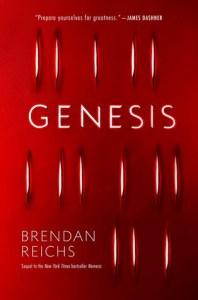
Genesis
Brendan Reichs
Noah knows what the stakes are now – and he’s determined to survive at any cost. He’ll flatten team-mates and set others alight to win. In contrast, Min knows that there has to be something more to life than killing. She wants to form a community and work out the long term goals. Why can’t they leave the area? And why does killing people not make them stay dead?
 I hated Noah and Min’s relationship. Honestly, I was disgusted by Noah most of the time, and I couldn’t believe that Min would fall for him. What about Tack? He would give her anything! And I’d take that any day in a killing scenario like what these guys find themselves in.
There’s a couple of twists and turns here that I definitely didn’t see coming. It is ESSENTIAL that you read Nemesis first, because otherwise you will be completely confused. How could Sarah do that? Why would they keep the psychopaths in the population?
I found it interesting that the gay couples still felt the need to justify their relationships. Maybe it’s because they won’t be able to provide offspring to somehow keep the human race alive? That’s the thing that got to me. Even if there are 64 humans left, it’s really unlikely that that is enough genetic diversity to really restart a population. And were the ones and zeros really needed? Or could those clone bodies survive on their own? I wanted to know more about the science.
I actually read an eBook copy of this as I was on vacation and had just finished Nemesis – and I needed to read Genesis right away! I have a hard copy version though which I did like originally until I realized it was the second in a series. What devastated me again after finishing it is that there is a third book. I’ll give this one 4 stars, but I probably won’t reread it before reading Chrysalis.

Pan Macmillan | 24th April 2018 | AU$16.99 | paperback


 Ah, I wouldn’t have called this The Bride Test. Is Esme really tested? Or is it Khai who has to decide what he really wants? I loved reading their different perspectives and how the times almost overlapped, and that arg! How could they both think such different things about the same interactions? Well, since Khai identifies as having Autism, yes, it’s clear how that can be the case. It’s nice to see a non-neurotypical writer commenting and writing on a topic that she is surely intimately familiar with.
 Lost Frequencies is the first book in The Soul Prophecies series and is set on the ancient, planet of Iyeeka, many light years from Earth and millions of years before the dawn of mankind. Iyeeka encounters many issues which humanity struggle with today. The story follows Zerren, Ehi, Ahrl and ten other characters as they travel across their dying world to the home of a time-travelling scientist in the search for answers to their problems. Iyeeka is not the place it used to be, changing weather patterns, natural disasters and increasing global temperatures have destroyed entire continents and left the last two continents barely habitable. Water shortages have left the southern regions completely desolate and their fleeing refugees have pushed the northern regions to their limits. Millions have perished over the last few centuries and some Iyeekans have turned to violence in order to survive.
 You know, you’d think that fiction characters, particularly those that have adopted children, would learn to be more open about things. Every time I get a side conversation being held between parents I automatically think that something is going to go wrong – and unfortunately that’s normally the main plot point of the novel, just as it is here.
 The process of figuring out who you are is both exciting and terrifying. For me, that process mostly happened during my four years of college and came to a perfect head when my anxiety, my bisexuality, and my androgyny all kicked in at once. These things opened new worlds for me to look into. I searched for hours online and read articles about people who had similar experiences to me with anxiety, sexuality, or gender. These searches often brought both positive and negative results, but either way, I learned a lot about myself and how the world tends to perceive people like me.
 I started writing my first gay love story (The Unseasonal Warm Front) in April of 2018. It was based off a short story I had written in high school, but my short story did not have a happy ending. It was not a love story, but a classic “gay guy falls for a straight guy” story. That was not the story I wanted to put out into the world. So, I read a lot of LGBTQAI+ young adult fiction, and I found a terrible thing: there were so few happy endings.
 About the Author
 How dumb can one girl be? It’s clearly obvious which side she’s going to pick. Oh boo hoo, your boy toy isn’t from the same place. Oh no! You might war with your parents for forever! Get over it! Choose based on what you see, not what people tell you. She’s all about being strong and kicking people in the balls (literally and figuratively) and then she’s just bowled over by good old Killian because he smells good.
 This novel was very, very slow and I considered giving up on it about half way through. Min and Noah are like two magnets that kept changing polarities. Oh, and then when the perspectives started changing I started feeling very irritated. Just stick with a side guys! Noah, please get over yourself, I get that you might have anxiety, but I don’t think you’re really convincing me with your character consistency.
 I didn’t feel convinced that Felix was 13. I felt that maybe he was a bit younger? I feel like by 13 I was a bit more put together, but maybe that’s because I’m a girl and we develop slightly faster than boys. I loved his relationships with his friends! And I liked how the novel was a mix of past and present tense – initially I felt a bit hesitant of it, but in the end it made sense.
 I expected something more like
  The premise of this novel is interesting. When children get to the age of 10 or so, they lose their ability to feel things. So then at high school they are taught society’s rules and norms for how to behave. Somehow people’s brains have switched off the pathways to being empathetic for others. It’s a cool idea! I’m not sure how biologically possible it is at this point though.