Review: Amelia Mellor – The Grandest Bookshop in the World

The Grandest Bookshop in the World
Amelia Mellor

Pearl Cole is sure that she lives in the greatest place in the world. She stays home, and reads on the topics that make her happy. She looks up to her Pa and loves her siblings. But one sibling has died, leaving a hole in the family that the mysterious Obscurosmith can exploit. Can Pearl and Vally save their arcade, or will it, and their memories, be gone forever?

This novel confused me. My daughter received it for Christmas and I grabbed it up – who wouldn’t want to read a book about a bookstore? I was then informed that it was based on a true location/story/event. However, although I was able to suspend my disbelief for some of the novel, eventually I was left feeling confused and a bit cheated. It might be a real location (as described in the historical note), with some of the games passed down from child to child, but it wasn’t a true ‘based-on’ novel.

I liked the magic system in this book. Magic works based on three things: imagination, articulation and conviction. But apart from that, there are no rules! Each person can shape the magic as they like to, and some are better at it than others. Some people are very successful at it, such as writers like Pa Cole, while others are not so good because they are too practical.

There were some laugh-out-loud moments where I giggled so much my birdie thought the world was shaking! The games were fun, and I got enjoyment out of trying to solve the riddles just from the information the children gave me. As the novel progressed, I had to work harder to keep the magic alive in my mind, and that spoiled the novel for me.

I love the idea of a bookshop where you can read as long as you like – I have some favourite memories of sitting in a bookstore, hidden from the staff, polishing off a novel while my parents shopped. Of course it’s frowned upon – but there aren’t any libraries in most store arcades! As digital books continue to take over, the historical artifact of a brick-and-mortar bookstore will fade. And I will be very sad, even if it’s just the idea that excites me.

I won’t reread it as the games aren’t fascinating enough for that, but I’d highly recommend it to its intended audience of children, say 8 years and older. 3 stars from me for adults, 4 stars for children.

Review: Timothy C Winegard – The Mosquito

The Mosquito
Timothy C Winegard

“Why was gin and tonic the cocktail of choice for British colonists in India and Africa? What does Starbucks have to thank for its global domination? What has protected the lives of popes for millennia? Why did Scotland surrender its sovereignty to England? What was George Washington’s secret weapon during the American Revolution? The answer to all these questions, and many more, is the mosquito.”

It’s that time of year where I try to purge the books that haven’t been read in a year from my shelf. Several have somehow missed by rader – perhaps I couldn’t face this one with another epidemic going on. I can think back to the end of 2019 and remember that I was very grateful that COVID-19 wasn’t vector-borne, because that would make it almost impossible to eradicate. Unfortunately, life a year on suggests that there is still more disease to deal with (as I write this review, the first vaccines are being administered in the USA).

Nevertheless, this is an interesting, if somewhat dense, book about vector-borne diseases – specifically those transmitted by mosquitoes. I somehow didn’t get past the introduction and first chapter, probably because my background as a mosquito scientist. There is a focus on malaria, which is of course the most ‘popular’ disease. My own mosquito-borne disease choice is dengue, so I wasn’t as wrapped in it. Dengue is an emerging epidemic, so it’s not really mentioned in here.

The chapter titles of this book are quite inspired! Unfortunately, for me it eventually turned out that I didn’t finish reading it. It truly was a history rather than a science-filled narrative of the mosquito. I’m just not that keen on history (coming from someone who thought that the ‘cold war’ was cold because it snows in Russian…).

A really cool fact I learn from this book was that malaria was used in the 1920s to treat syphilis! The guy that thought of the idea got a Nobel prize, and so people would line up to be given malaria in order to treat their STI. Then a couple of years later we discovered antibiotics, thank goodness!

You’d be forgiven for thinking that this was a hardback at this price point, but sadly it isn’t. It’s solid book that is going to be the perfect gift for someone who loves history.

Text Publishing | 20 October 2019 | AU$32.99 | paperback

Review: Elisabetta Dami – Thea & Geronimo Stilton Mouse novels

Superstore Surprise
Geronimo Stilton

“It’s the grand opening of Traps new superstore, but nothing is working. The lights won’t turn on, the doors won’t open, and the loudspeaker is broken. Geronimo must figure out who is trying to sabotage the grand opening!”

Scholastic | 1st December 2020 | AU$12.99 | paperback

The Magic of the Mirror
Thea Stilton

“The Thea Sisters are summoned to the Seven Roses Unit by Will Mystery, but when they get there Will is missing! The sisters must follow a trail of clues to the Fantasy Kingdoms on their quest to find Will.”

Scholastic | 1st December 2020 | AU$19.99 | hardback (special edition)

Both these books are children’s fiction which I normally wouldn’t request. In fact, they are weird because they are by the same author, but are written under the pen names of their mice protagonists – Thea and Geronimo Stilton. Thus although these are written in the same universe, a child requesting this book wouldn’t know that they are by the same author! And I personally wouldn’t know how to categorize them in an alphabetical-by-author bookshelf.

These two beginning reader book are quick and quirky to read as an adult, and perfect for their intended age bracket of children in grades 2-4 (reading level 4). The font is large, and interesting/important words are emphasized to give some lightness to the reading.

Obviously I’m not the target audience for this. Upon watching my 11 year old daughter read other books by these mice, she laughed and giggled at multiple points – so I’m taking that as a good sign! I’m not 100% on whether these would suit young male readers as well, but they are short and engaging enough that having them read out loud by a beginning reader wouldn’t be too painful.

Both of these novels have been brought by Scholastic into English reading (they were originally written in Italian), but I imagine that the original novels would be just as good. I wonder whether a case could be made for immersion reading in a foreign language? There are some made-up words though, such as ‘fa-mouse-ly’ and I wonder how that worked in the original Italian. But I digress.

I’d confidently put these on the list for buying as a gift for a beginning reader, and suggest them as staples in a school library. The hardback of The Magic in the Mirror is beautiful with top-notch full-colour images inside. I can’t say anything about their rereadability.

NB: This review will be updated with an 11 year old’s perspective some time in January! I very sneakily asked my daughter which of the Scholastic Trade Parade she was interested in, and then hid them until Christmas!

Review: Laura Greaves – Extraordinary Old Dogs

Extraordinary Old Dogs
Laura Greaves

“Puppies are wonderful, but there is something truly special about an old dog. It’s the grey muzzle and salt-and-pepper eyebrows; the face that says ‘been there, sniffed that’. More than anything, it’s the lifetime of love, laughter and licks.”

This non-fiction book about senior dogs was quite an interesting read, but also a disappointing one. I had previously enjoyed Greaves’ Miracle Mutts and was keen to give this one a read. However, this book didn’t live up to the promise of its title. Yes, it certainly discussed old dogs, but I don’t think they were actually ‘extraordinary’.
To give some context, I grew up in a household where dogs were working dogs on a farm. We never kept a dog that was unsuitable for the (hard) farm life, but we weren’t cruel either. Dogs lived out their time on the farm – they weren’t surrendered or slaughtered for being old. Other dogs I’ve met all have lived out their lives at home – even those in the care of complete strangers! So to me, it was a bit of a surprise that there was even a bias against old dogs.

These dogs were all old, but I don’t think their stories were particularly unique for being old. It was more that the majority of these dogs were rescued – adopted in their old age after someone had surrendered them to the Pound. Thus I felt cheated that these dogs were old, but they were more interesting for the fact that they had entertaining personality types, or fascinating back stories prior to adoption. To be fair, some dogs were with their humans for their whole lives, and those dogs were themselves interesting on how long a dog can live under the most optimum conditions.

I did learn some interesting facts, such as that the old adage that “one human year = seven dog years” is really incorrect (different breeds age differently), and that it is possible to train a dog to find koalas. At times, the author seemed to rely on old news articles for details rather than information presumably straight from the owners’ mouths. Perhaps these stories are less about the dogs, and more about the social media accounts that their owners set up for them!

I’m honestly not sure this book is worth the price tag. It’s not something I would have a compulsion to read more than once, and I’m not sure who I would buy it for. Perhaps if you have someone who had truly cared for their old dog, or are thinking about getting a new pet, this would be an appropriate gift.

Penguin Random House | 1st December 2020 | AU$34.99 | paperback

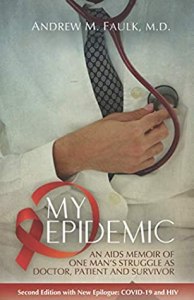
Review: Andrew Faulk – My Epidemic

MY EPIDEMIC
An AIDS Memoir of One Man’s Struggle as Doctor, Patient and Survivor
Andrew M. Faulk

“When young Dr. Andrew Faulk first learned he was HIV-positive, he was devastated for it certainly meant imminent death… Due to the rigors and stress of training, he considered abandoning his medical career. But, instead, he dedicated the remainder of his life to the fight against AIDS, ultimately participating in the care of approximately 50 patients who died, many his own peers, including his partner.”

What is there I can say about this book? It is both heartbreaking and uplifting, sad and joyful at the same time. The memoirs that I have read recently didn’t pass muster. My Epidemic does. Andrew shows sensitivity and self-awareness, and his story does bring something new to the bookshelf. To me, Andrew showed the early tenants of ‘active listening’ to his patients, even as he faced most of them going too-early to the grave. This naturally took a toll on this compassionate doctor, leading to him leaving the profession.

This is a book by a man who knows how to actively listen, who knows how to empathise and grieve, and is willing to share what story has taken place in his life so far. Personally, I felt cheated to an extent. This memoir is filled with two page summaries of patients and friends Andrew has known and nursed. I wanted more information – but perhaps to include more would have crossed the confidential patient-doctor boundary.

I particularly appreciated the epilogue on COVID-19. Thankfully, Australia has not been as hard pressed by COVID-19 as the overburdened USA healthcare system. It didn’t occur to me to parallel the two epidemics. HIV/AIDs seems to be so far in the past – I always thought of AIDs as belonging to third world countries (reinforced by other books I had read). I’ve read novels on the 1980s epidemic or current life with HIV, but they didn’t resonate with me in the same way as this memoir.

When I corresponded with Andrew and his publicist, I felt listened to and appreciated (he even addressed my beloved birdie in my signed copy of the book!). Treating your reviewer with respect for their time will always lead to a tick in my book, and lead to this book being read almost as soon as it arrived.

The gay men in my life are HIV-negative as far as I know, and I know that many are taking PReP to minimize their chances of contracting HIV. Advances in medicine such as these have changed the face of disease burdens and perhaps minimized their significance, in Western countries at least.  Thank you Andrew for bringing the AIDs epidemic back into context and not letting those brothers who were victims of this disease be forgotten.

Review: Robin Sloan – Sourdough

Sourdough
Robin Sloan

Lois’ stomach can’t cope with proper food any more, she just feeds it slurry. Her job as a software programmer leaves her stressed and unable to eat. She finds to her surprise however that she can eat ‘double spicy’ and sourdough bread baked by two brothers. When they have to leave the country, they leave her with the start for their sourdough – she must nurture and feed it, and eventually it takes over her life.

I found myself laughing out loud sometimes at the tricks the starter got up to! I wasn’t in the least surprised that it didn’t seem to behave itself like normal starter. I loved the way that Lois gradually became more confident looking after it, and looking after herself.
The romance was subtle, and the sourdough starter supreme. There were elements of technology (solving ‘the egg’ problem was particularly good) and also of what it’s like to work in a high-stress environment. A woman breaking through coding and IT was also refreshing. Somehow it was trying without being trite.

I very much enjoyed it, except the ending. I wanted the starter to keep being awesome! I didn’t want it to mix with the slurry! And I felt a bit betrayed, as a scientist, that there was so much underhanded dealing going on.

This was lent to me by a friend that I share the bounty of our garden with (and vice versa). I’ve not read Mr. Penumbra’s 24-hour Bookstore, although the title agrees with me. I’m going to give this one 4 stars, and highly recommend it to anyone who just feels like a feel-good read.

Review: Brigid Kemmerer – More Than We Can Tell

More Than We Can Tell
Brigid Kemmerer

Rev is tortured by his father, both in his past and present. He’s confused by his own strength and doesn’t know how to interact with anyone other than Declan and his adoptive parents. Emma is more comfortable online than in real life, and dreams of becoming a game designer. Her parents don’t understand, and they don’t understand why it’s important to her.

This is a second novel that is set in the world of Letters to the Lost. The characters overlap, but it’s not essential to review Letters to the Lost first or anything. We learn more here about Rev Fletcher, Declan’s friend. What was a tortured shadow friend now becomes a tortured soul that we get to see into.

I cried! Oh, all the feels. Rev’s story is heartbreaking and yet typical for many abused children in foster-homes. Really, Rev is lucky because he’s able to be adopted by a family who cares about it.

Do they always have to fall in love? Can’t they just not for a change? What’s wrong with making an amazing friend? Teenage love is great and all, but speaking as a voice with experience, it doesn’t always end up that this is forever love. When they rely on another person to keep them stable, it doesn’t bode well for the future.

While this got the review of my wife as ‘yet another YA novel with one of those covers’, I enjoyed it. I have to agree on the cover being a bit bland and in line with all of the other YA novels that depend on their title to draw the reader in. I have a couple more of this type of novel on my shelf, and I haven’t felt motivated to read them. Instead, I’m finding myself drawn towards non-fiction – maybe that’s because it’s been a hell of a year and I want something solid to read.

I requested this novel from Bloomsbury over a year ago, but never received a copy. Having enjoyed Kemmerer’s other novels though, I bought it for myself as a Christmas present last year – I don’t regret it at all. I can see myself reading it again, so it’s 5 stars from me.

Bloomsbury | paperback

Review: Tanya Huff – Gate of Darkness, Circle of Light

Gate of Darkness, Circle of Light
Tanya Huff

Darkness is coming, and it’s up to a 2/3 trained Bard, a simple woman, an over-worked social worker and a bag lady to stop it. Oh, and a perfect but overly emotional Aspect of Light. Toronto will never be the same.

You’d think that with three female characters you’d see some serious woman-kick-ass but nope, the focus still seems to be on the paranoid Bard and the too-hot-to-be-human Aspect of the Light. Oh, and two random cop characters. This novel was such a mix of perspectives I’m not surprised that I hated it.

I honestly don’t know why I kept reading this novel. Perhaps a fear of missing out on the train wreck? Honestly, I hated the characters so much that I hoped they all died in a burning fire / were taken by the Dark. I had difficulty skimming through it simply because it was an eBook. I could sworn I had read other books by this author and enjoyed them, so I thought maybe it could redeem itself!

Roland is tortured, doesn’t know what he’s doing with his life and fears all possible hints that he might be gay. He’s also not quite a bard, which seems to be the least of his problems. We also see a neurodiverse cast member in the shape of Rebecca who is simple and thrives on rituals to keep her life stable. I think what we are supposed to believe about her is that it’s not a bad thing that she is ‘stupid’, but it honestly comes off as trite and ultimately unfulfilling.

The author seems to be playing with the fact that life revolves around sex – one of the tactics used to delay the Light is by basically making him a sex god! There’s nothing normally wrong with this, but it’s unclear to me why the author decided that some awkward male-male bonding was necessary. It made it seem like being gay was a problem!

Ultimately this should have been a 1 star novel. I shouldn’t have kept reading it, but was somehow too invested (or bored at work) to stop. I’m disappointed and I think I won’t be touching anything by this author for a long time until I’ve forgotten how awful this one was.

Review: Kevan Van Whye – Date Me, Bryson Keller

Date Me, Bryson Keller
Kevin Van Whye

Bryson’s got a dare going – he has to date the first person to ask him out on a Monday morning. Kai has a secret – he’s gay, and perhaps a nice guy will notice him eventually. When Kai basically blurts out that Bryson should date him for a week, he doesn’t actually know what the week will have in store.

This came in the door, I read it right there and then, and then failed to review it. What can I say, COVID-19 has been sapping my energy because I spend way too much time in front of a screen. This is a heartfelt romance that starts out just as I would expect it to. Gay boy falls for straight boy, but there’s no gay baiting! Beautiful.

Kai is such an empathetic individual that it almost made me cry at times. I couldn’t bear it when he was hurt! And Bryson goes from a popular kid on a pedestal to being, well, human. Both are full realised characters that I enjoyed reading about.

I also really liked the cover. Mine was an ARC so it didn’t exactly match the one here, but it was cute. Oh, and did I mention that the Penguin on the spine (because it’s published by Penguin Random House) has a rainbow background? It would be easy to browse a (physical) bookshop and find a Queer novel that’s suitable for a young person in your life.

This novel is a cute love story that still manages to cover queer-phobia and coming out without being trite. I wouldn’t hesitate to recommend this as a teenage read, gay or straight. If you are looking for a gay novel that is a little more racey, try Jack of Hearts or CAMP. Oh! Or The Gravity of Us. There are some really excellent novels out there at the moment.

My only hope is that this book doesn’t trick young queer people into thinking that they can bring people over to being queer! But then, I imagine that they are already sick of reading straight romances where the queer person is the best-friend/side-kick/support-person. I had to resist rereading this again when I was going to review it, so it’s 5 stars from me.

Penguin Random House | 2nd July 2020 | AU$15.99 | paperback

Guest Post: Sophie Whittemore on ‘Writing an LGBT+ Found Family’

A Guest Post with Sophie Whittemore, “Writing an LGBT+ Found Family”

Family isn’t necessarily just the bonds formed by blood. A found family is a connection through shared experience.

And having that shared experience is a strong tie in the LGBT+ community.

And this, the concept of an LGBT+ found family, was what I wanted to explore with my punk fantasy mystery novel Catch Lili Too (Book 1 of the Gamin Immortals Series). The book’s main character, the asexual siren detective Lili, finds herself slowly building a queer found family of her own. Together, the cast of living, reanimated, and immortal beings help each other past internal struggles and external battles against the living (and the dead). And that family bond draws them tight, even when the world (and a rampant string of supernatural killings) threatens to tear them apart.

A found family isn’t bound by just one definition. There are also intersections of identity based on race, religion, ability, gender, and more. The LGBT+ found family is one that is built of a shared experience of being a part of the LGBT+ community, and all the wonderful rainbows of identity that might follow.

Especially considering that young people might end up in the street for coming out or otherwise disowned later in life, the found family becomes an incredibly integral part of the LGBT+ experience (though not all LGBT+ people find it so easy to gain a found family as this varies by whether or not being LGBT+ is legal in their respective geographies).

However, in fiction, one’s bonds with the character aren’t limited to geography. One can travel the world through the pages of a book. And an LGBT+ found family can be presented for someone who never knew that was a possibility.

Even if someone lives in a place that isn’t accepting of who they are…

They should still be told they are accepted, even if it’s through a book.

Often, we see the found family literary trope presented as ragtag groups of superheroes or a team of misfits in heist films. However, it’s important that, through fiction, LGBT+ people can see themselves represented as having a found family and being in an environment that is accepting and understanding of their experiences. Fiction gives them the validation and acceptance that they might not know exists otherwise.

Coming out and joining the LGBT+ community, reckoning with my gender and sexuality, wasn’t an easy process. I am so incredibly grateful I had amazing, understanding friends along the way. And honestly, when I was in the closet and didn’t have the vocabulary to say what I felt and understood about myself, watching media was the only way I knew how to make sense of myself. The main characters in Catch Lili Too have their own coming-out and coming-of-age experiences (yes, even immortals and undead young adults manage to have those too), and it was important that they not be alone in it.

I remember reading a book about a knight who presents as a different gender in a fantasy novel and thinking “this feels right” when I read it. I remember reading fantasy novels where the hero feels like they don’t fit quite right into society, like an outcast for things beyond their control. I remember thinking if they can accept themselves, so can I. So, I wanted Catch Lili Too to also have that, to show people they aren’t alone.

I know there’s no one book or movie or video game that can perfectly encapsulate a person’s life experience. However, I want to continue writing about LGBT+ found families in fiction because I want young LGBT+ and questioning kids and adults and all people to read fantasy and think:

That’s me.
And if that character is accepted…
Then I can be too.

About the Author

Sophie Whittemore is a Dartmouth Film/Digital Arts major with a mom from Indonesia and a dad from Minnesota. They’re known for their Gamin Immortal series (Catch Lili Too) and Legends of Rahasia series, specifically, the viral publication Priestess for the Blind God. Their writing career kicked off with the whimsical Impetus Rising collection, published at age 17.

They grew up in Chicago and live a life of thoroughly unexpected adventures and a dash of mayhem: whether that’s making video games or short films, scripting for a webcomic, or writing about all the punk-rock antiheroes we should give another chance (and subsequently blogging about them).

Sophie’s been featured as a Standout in the Daily Herald and makes animated-live action films on the side. Their queer-gamer film “IRL – In Real Life” won in the Freedom & Unity Young Filmmaker Contest (JAMIE KANZLER AWARDS Second Prize; ADULT: Personal Stories, Third Prize) and was a Semifinalist at the NYC Rainbow Cinema Film Festival.

Their prior works include “A Clock’s Work” in a Handersen Publishing magazine, “Blind Man’s Bluff” in Parallel Ink, a Staff Writer for AsAm News (covering the comic book convention was a dream), and numerous articles as an HXCampus Dartmouth Correspondent. Ultimately, Sophie lives life with these ideas: 1) live your truth unapologetically and 2) don’t make bets with supernatural creatures.

You can find more information about Catch Lili Too here.

You can find out more about Sophie on Twitter, Instagram, Facebook, Tumblr, GoodReads or on her website.