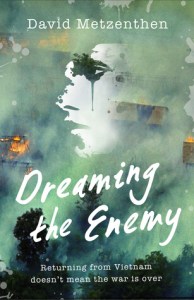
Dreaming the Enemy
David Metzenthen
Although Johnny Shoebright has returned from the jungles of Vietnam, he remains haunted by the acts he was forced to carry out, and the ones he endured. He fears the living, and finds it hard to believe that anyone could possibly feel like he does.
 It’s the 20th anniversary after the Vietnam War. Since this novel was published and made its way into my hands I have seen a bunch of novels on the same topic. I know better than to ask for them though. I’m not even sure I asked for this one.
There’s just something about the prose and the interlacing of fact and fiction that didn’t do anything for me. The dreams of Johnny are very different to the life he finds himself in now, and I accept that it is probably a genuine choice of the author. Johnny himself is split between the person he ‘should be’ and the person he is. Brilliant execution, just not the right subject.
I think it’s just me. I’m not particularly interested in war stories (says the person who read Max, and enjoyed it), and so this perhaps never would have worked for me. I’d love to be proved wrong, but my rule of generally rejecting novels about wars seems to be the right choice for me at the moment.
I feel guilty, but I only got about half-way into this novel before I was distracted by something else shiny. I did read it solidly, paying attention to the details, but in the end, I just couldn’t bring myself back to read it. I’m giving this only 2 stars, I think that for the right audience it would be a hit – that audience is just not me.


 By the feel of things, I think the authors had a wide scope of what they could write. For me, I hate poetry. I especially hate random poetry where I can’t work out any of what is going on. Other examples were of not-true stories. What is the point of writing expository fiction if your reader can’t connect in any way with it?
 I couldn’t put this novel down. I think I start almost every Brandon Sanderson novel in that way. I didn’t realise it was out until an ill-timed comment from my partner just as I was going to sleep. I then had trouble sleeping because I wanted it right then and there. I begged to have it the next day, but I ended up getting it the day after and polishing it off in a single sitting.
 Why do people lie? Seriously guys. Ugh. It seems like everyone is crossing everyone, except Percipience who I loved (having loved the set-up of it in the first place).
 I want to feel sorry for Epoch, and yet at the same time I don’t. If Clyde can understand this different way of living, others can too. Or is it that in Percipience people who were like that have been wiped out? Nature vs nurture things here.
 Leila is challenged by her Persian background, and I learnt a lot about that culture just reading this novel. I particularly loved the way Leila’s older sister was characterised. I could have had more here!
 I think it is more that their lives have already fallen apart, and that the collision is going to bring only good things. A big mess can only start to clear up right? Vivi is a disaster some of the time, but she at least has a good grasp of life (to an extent). Vivi are so different in what they know about the world, and together they can conquer anything.
 I cannot be thankful enough for the novels that are normalising uncomfortable issues at the moment, such as bipolar disorder,
  Honestly, this novel wasn’t quite right for me. It’s history, written in a sort of fictional, accessible format. Unfortunately I’m not interested in history at the best of times. I was hoping that this novel would pull me in a bit, but it wasn’t quite powerful enough to overtake me. I read selections of this, and enjoyed those. I made sure to just pick those ones though, English history bores me silly (but I can totally go for the Berlin Wall).
 From the very beginning you already know there is something wrong about the way the twins have been treated. The more you read, the more you work out what is going on – even if it is exactly what the burb described and you aren’t ever really confused.