The Subversive Act of Writing
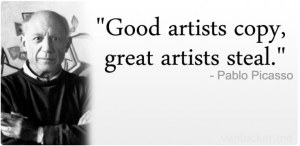
Originally this article was going to include the idea best covered by a quote attributed to Pablo Picasso “Good artists copy; great artists steal.” The subversive act of taking ideas from other sources and making them your own. But great writers are not only thieves, they tend to be rule breakers.
 We all know some rules are made to be broken, because they were poorly thought out in the first place, but many great authors have overturned the window of what is acceptable in writing by figuring out when a previously sacred rule should be broken. Now I’m not one of the greats, but I do love breaking rules. The minute someone tells me one I’m already wondering how I can break it. It’s a mini act of rebellion against the fusty old English teachers who tried to teach me grammar. I revel to know they’ll be turning in their metaphorical graves the moment I start a sentence with a conjunction, or use a sentence fragment. And yet it’s something that great authors do. All the time.
Not so long ago, I was teaching a class of young writers, and some of them started telling one of the more experienced students, “Hey, you can’t do that, it’s against the rules…” Ugh. Writers have one job, and that’s to tell our story the best way we can.
There is nothing else.
That means looking at our toolbox and finding the right tools for the job – not throwing out the wrench—or in this case, the first person point of view because somebody told you to only write in tight third person. (That’s writing in third person, but tightly within the bounds of a character’s perspective.) If everyone followed that “rule” the unreliable narrator would never exist.
There are hundreds more rules writers are supposed to follow, like:
- Don’t use passive sentences
- Don’t use filter words
- Don’t bore your reader
- Show don’t tell
- Have a likeable character
- Write what you know
- Don’t use adverbs
- Use proper spelling and grammar
- Don’t get to the end of your story and have it all be just a dream
Every single one of them will have exceptions.
 A famous example of blatant rule breaking is Iain Banks’ story Feersum Endjinn. Iain wanted to tell a story about a nearly illiterate character, so he did the unthinkable, he made his readers wade through pages of phonetic writing. And it worked. Even though many people really hated the book because of this choice, I believe it was the best way of presenting that character.
Instead of wading through examples, which you can look up with the magic of the internet, I thought you might enjoy a quick writing exercise.
Choose a writing rule that you would never, ever break. (It doesn’t need to be from the list above.) Take a moment to mull over why the rule is so important.
Now, what would it take for you break to that rule? Can you think of a story, or a paragraph, in which the rule must be broken to truly work?
Once you’ve done this exercise—or if you’ve already done a variation of it—you have become a subversive writer. You’ve looked at the world, broken down its rules and taken another path. A path less travelled. Do not be surprised if you start to see the world differently. The rules you live with every day may start to seem poorly thought out, or even designed to oppress certain people.

One of my favourite authors, Ursula K. Le Guin said, “There is no more subversive act than the act of writing from a woman’s experience of life using a woman’s judgment.” I would expand that to include any person who has truly thought about rules, and how they should be broken to make something better.
So go on, break some rules—be subversive with your writing. It’s a lot of fun. And it’s freeing. If you check out my blurb for Quest, it’s pretty clear I’ve broken at least three popular rules, and that’s without knowing that it has in fact been written by an unreliable narrator. Seriously, unreliable narrators may be tricky, but they are the most fun.
Or, now that you know how subversive writing really is, don’t break any rules. What do I know about your story? When it comes to writing, there’s only one rule that I consider unbreakable: Tell your story the best way you can!

About A.J. Ponder
Sir Julius Vogel and NZSA award winning author, A.J. Ponder has a head full of monsters, and recklessly spills them out onto the written page. Beware dragons, dreadbeasts, taniwha, and small children—all are equally dangerous, and capable of treading on your heart – or tearing it, still beating, from your chest.
Blurb: Quest
Sylvalla escapes Avondale castle, and the life of a princess, in search of the adventure she’s always wanted.
Once found, adventure bites back.
Fortunately Sylvalla is not alone – Unfortunately, her new-found companions are less than heroic. Jonathan would rather make money. Dirk would rather live a long and happy life. And at 150, Old Capro would rather stop gallivanting about and harangue unsuspecting students about his glory days over a nice cup of tea.
Quest has everything, heroes, monsters, chases, escapes and a complete lack of true love.
 Tris seems to lack a survival instinct, as well as an ability to actually communicate with people! So much drama could have been avoided by ‘using her words’. The same goes for the rest of the characters – talking is a good thing, people! This frustrated me at times because it meant that the perspective was very limited from Tris and I thought there was so much more about this world that I could have enjoyed if I had been given a chance.


 Noah’s perspective is interspersed with his mentor’s and a potential love interest. This gives the reader a bit of variety, and also makes them feel Noah’s growing sense of horror as he realises what he and others have done in the name of safety. I wanted to be horrified when Noah tortured people, but I just wasn’t. I felt as numb as he did.
 This novel put the creepy factor up high right from the beginning and it only got worse (or better?)! This is a true psychological thriller that caused me to shiver and make sure I had a good grip on myself (and my stomach). Some of the passages when Naomi were alone almost took my breath away.
 It’s very difficult to review a book that is filled with images – you just need to see them for yourself. For example, there is an Escher tattoo and some visual puzzles that if the artist had gotten a tiny bit wrong, it would have been wreaked. There’s a kitten and a dinosaur, and you better believe every hair on that kitten is visible.
 I’m not sure if I have commented on this before, but I’m not sure how I felt about the interspersed writings of the Archivist and his lackeys. Did I really learn anything new? What was their effect on the novel’s progress? (maybe these questions are left over from marking literature reviews…) Nevertheless the rest of the writing is fine and you barely realise that you are turning pages at a rapid rate.
 I read about half this novel while waiting for the action to begin. I’m sorry, I just don’t find it that entertaining that she forgot nipple pads, and whether breast milk has DNA in it. I continued reading after a month or two had passed and still felt underwhelmed. The ending promised to have a little more action in it, but in the end it felt rushed and unfinished. I needed significantly more shadowing throughout the novel to feel convinced about the betrayals…
 The detailed gore at the beginning of the novel was cringe worthy and my feeling was that it was unnecessary. The torture might have been intended to make things feel Gothic and gloomy, but instead I just felt revulsion. I also couldn’t work out why I should care about David and Thomas. What were the men’s purposes in this novel?
 The photos in this book are enough to make you drool and then go for a hunt in the freezer for a cookie (jam drop or choc chip? Yes please!). The discussion of the literature is also thoughtful and might introduce you to a couple of little known classics that might take your fancy. I only wish I was part of a book club so that I too could bake some amazing cookies in the theme of the book of the month.